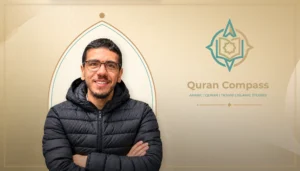
Mr. Abdallah Anwar
Arabic | Quran | Tajwid | Islamic Studies
Quran Compass is an online Arabic academy offering live 1-on-1 classes with native teachers for adults and children. Our Arabic vocabulary course starts with the most common words, then connects them to daily conversation and the language of the Quran, with lessons planned around your level, goals, and Netherlands time zone.
ABOUT THIS COURSE
In this course, you'll learn more than 1,500 of the most useful Arabic words across four levels, in live 1-on-1 lessons with a native teacher. You start with core words like pronouns, question words, numbers, and basic verbs, then move on to everyday vocabulary for home, school, work, food, and travel, followed by the words that repeat most in the Quran, salah, and daily duas.
You'll also learn how Arabic roots and word patterns build families of related words, so you can guess new vocabulary on your own. Every word is practised in sentences, conversation, reading, and listening, and reviewed at planned intervals so it stays with you. By the end, you can hold everyday conversations, understand the general meaning of your prayers and short surahs, and keep learning independently.
WHAT YOU LEARN
Six core areas take you from your first words to confident understanding of everyday Arabic and Quranic language.
You'll master the high-frequency words that make up most everyday Arabic, such as pronouns, question words, numbers and the most-used verbs. A few hundred of these core words cover a large share of what you'll hear and read. This is the fastest way to start understanding real speech and text, and it gives you visible progress from your very first lessons.
You'll see how three-letter roots create families of related words. For example, the root k-t-b gives you kataba (he wrote), kitāb (book), maktab (office) and maktaba (library). When you understand roots, every new word links to words you already know. Memorising turns into recognising, and your vocabulary grows much faster.
You'll learn words for greetings, family, food, shopping, travel, school, work and time. Then you'll use them straight away in short live dialogues and role-plays with your teacher. Speaking new words out loud in real situations helps them stick. It also builds the confidence to talk with Arabic-speaking family, friends and people in your community.
You'll learn the words that repeat most often in the Quran, in salah and in daily adhkar and duas. Your teacher shows you where each word appears in familiar surahs, like Al-Fatiha and the last juz'. Little by little, you'll understand what you recite, and that makes your prayers feel more meaningful and focused.
You'll learn the key verb and noun patterns (awzan) that shape Arabic words, such as the patterns for the doer, the place and the action. Once you know these patterns, you can often guess the meaning of new words you've never seen before. This skill makes you an independent learner who keeps growing even outside class.
You'll meet your new vocabulary in short texts, simple stories, audio clips and Quranic verses matched to your level. Regular reading and listening train your eye and ear to recognise words naturally and quickly, in context. You'll also learn to pick out familiar words in native speech, and that step leads to real comprehension.
FIT CHECK
This is the most common story we hear from families in the Netherlands. Your child finished Qaida at the mosque, or you learned to recite as a kid, and you can read a whole page fluently without knowing what a single line means.
Vocabulary written on a worksheet is usually forgotten by the following Saturday. What makes a word stick is saying it, hearing it and using it in a sentence, several times, spread across several days.
Many of our adult students have a streak they broke long ago in a vocabulary app, and a phone full of flashcards they never open.
No fixed prerequisite — level is checked first.
Free first class
Try one free class: the teacher checks the level and tells you exactly where to start.
WHAT YOU WILL LEARN LEVEL BY LEVEL
Four clear levels, each with defined goals, so you always know how far you've come and what comes next.
You'll learn around 300 of the most common Arabic words, including pronouns, question words, numbers, colours, family members, parts of the day and the basic verbs used in almost every sentence. Each word comes with its correct pronunciation, a picture or example, and a place in your personal word bank. You'll learn to build simple sentences and answer everyday questions in Arabic, such as What's your name?, Where do you live? and How many brothers do you have? Short speaking drills in every lesson move these words from recognition into active use.
You'll expand to around 800 words covering home, school, work, food, shopping, travel, weather and time. Words are taught in themed groups, so each lesson feels like a real situation, not a random list. You'll start working with Arabic roots and word patterns, learning to spot how darasa (he studied), madrasa (school) and mudarris (teacher) belong to the same family. From this point on, your vocabulary grows faster, because new words start connecting to ones you already know.
You'll focus on the most frequent words in the Quran, together with the vocabulary of salah, adhkar, common duas and everyday Islamic phrases. Many of these words repeat hundreds of times across the Quran, so each one you learn pays off again and again. You'll learn to recognise these words inside short surahs and well-known verses, and your teacher will guide you through the meaning line by line. Recitation stops being just sound and starts carrying meaning.
You'll learn advanced verbs, abstract words and useful expressions for opinions, feelings, reasons and ideas. You'll also learn the linking words that turn short sentences into longer, natural Arabic. You'll read longer texts, short stories and simple articles, and follow native audio and video with growing independence. Your teacher gradually steps back, so you practise working out meaning on your own.
Free first class
Start with a free trial class: the teacher finds the right level and plans the path to each milestone.
What the First Month Looks Like
Every month, your teacher sends you a short report with clear numbers and next steps. Parents who don't speak Arabic can still see exactly what their child has achieved.
The Full Curriculum
Short class snippets show how the teacher explains, listens, corrects and confirms progress.
.
See it for yourself
Book a free 30-minute class with a certified teacher, on Dutch time.
Teacher match
Teacher language, speciality and availability are considered before the regular schedule starts.
Arabic | Quran | Tajwid | Islamic Studies
Arabic | Quran | Tajwid | Islamic Studies

Arabic | Quran | Tajwid | Islamic Studies
Real progress
See measurable examples from learners who started at different levels.
Families and learners
Real experiences connected to this learning route: written progress stories, video feedback and verified reviews.
Very helpful and helped me learn memorize the quaran
Alhamdulilah I’ve had the privilege of studying Quran, Arabic, and Tafsir througj Quran Compass. The class timings are very flexible which I appreciate as a busy college student. I’ve learned so much and am excited to continue on this path of sacred knowledge.
The times for the classes are very flexible. I have gone from barely being able to read the arabic alphabet to now being able to read quran.
Compare
| Quran Compass Course | Vocabulary Apps | Self-Study Books | |
|---|---|---|---|
| Word selection | Chosen for your level and goals | Generic lists for everyone | Fixed textbook order |
| Speaking practice | Live conversation in every lesson | Little or none | None |
| Correction and feedback | Instant feedback from a native teacher | Automated only | No feedback |
| Quran connection | Quranic vocabulary built into the course | Rarely included | Depends on the book |
Based on typical options for families in the Netherlands.
Book a free first class and we will identify the right level and next milestone.
Book a free trialContinue exploring
Compare nearby routes before choosing the best starting point.
Ages 6–14 · live one-to-one Quran reading with correction, Tajweed foundations and weekly progress.
View courseAges 6–14 · live one-to-one Quran reading with correction, Tajweed foundations and weekly progress.
View courseAges 6–14 · live one-to-one Quran reading with correction, Tajweed foundations and weekly progress.
View courseAges 6–14 · live one-to-one Quran reading with correction, Tajweed foundations and weekly progress.
View courseAges 6–14 · live one-to-one Quran reading with correction, Tajweed foundations and weekly progress.
View courseYour First Class Costs Nothing. Start Today.
Book a free trial lesson and meet your teacher. We'll check your level and show you your personal vocabulary plan. There's no commitment and no payment needed to start.