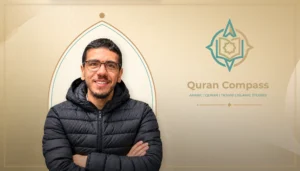
Mr. Abdallah Anwar
Arabic | Quran | Tajwid | Islamic Studies
How do you calculate zakah on savings held in euros? What breaks a fast during long Dutch summer days? Is a product in the supermarket halal? Our Fiqh Course gives Muslims in the Netherlands clear, reasoned answers to questions like these. In private live classes, you study fiqh chapter by chapter, from the sources of Islamic law to the practical rulings of prayer, fasting, zakah, Hajj, food, and earnings, with your teacher explaining not only what the ruling is, but why, so you can practise your religion with certainty.
ABOUT THIS COURSE
This Fiqh Course opens with the foundations of Islamic law: the sources of rulings, the five categories of rulings, and why the four Sunni madhhabs sometimes differ. You then study purification and prayer, including conditions, pillars, and invalidators, and practical situations like praying at work, combining prayers when travelling, and making up missed prayers. Each ruling is presented with its evidence, in plain English.
The second half covers fasting, zakah (nisab, the 2.5% rate, recipients, and zakat al-fitr), and an overview of Hajj and Umrah. The course ends with the fiqh of daily life, including halal and haram food, lawful earnings, and riba, so you can make informed choices in the world around you.
WHAT YOU LEARN
Our fiqh of worship course is organised into six subject areas, moving from the principles of Islamic law to the rulings you apply every week.
Learn the four sources of fiqh and the five categories of rulings. Understand how scholars derive rulings from evidence.
Study the conditions of valid purification and the rulings on impurities. Learn how scholars resolve common doubts about taharah.
Learn the conditions, pillars, and obligations of salah and what invalidates it. Cover travel prayer, combining prayers, and prayers you've missed.
Understand who must fast, who is exempt, and what breaks the fast. Learn how fidyah and making up days work.
Calculate zakah on savings, gold, and business assets using the nisab. Get an overview of the pillars and obligations of Hajj and Umrah.
Learn the rulings on halal food and slaughter, lawful earnings, and riba. Apply them to everyday choices in Dutch society.
FIT CHECK
You've learned how to pray and fast, and now you want to understand the rulings and evidence behind each act.
From zakah on a savings account to fasting during exam season, you want reliable, reasoned guidance.
You want a structured study of fiqh that explains differences of opinion instead of adding to the confusion.
No fixed prerequisite — level is checked first.
Free first class
Try one free class: the teacher checks the level and tells you exactly where to start.
WHAT YOU WILL LEARN LEVEL BY LEVEL
Our basic fiqh course is divided into four units, each building on the last and each ending with real-life case questions.
Study the four sources of Islamic law and the five categories of rulings. Learn about the four Sunni madhhabs and how to approach differences respectfully.
Learn the rulings on purity, impurities, and the conditions of a valid prayer. Study the pillars and obligations of salah, travel prayers, and making up missed prayers.
Learn the rulings of Ramadan, exemptions, and making up fasts. Calculate zakah on different types of wealth and learn the eight categories of recipients.
Get an overview of the rulings of Hajj and Umrah, and the difference between the two. Study the rulings on halal food, lawful income, and riba in modern life.
Free first class
Start with a free trial class: the teacher finds the right level and plans the path to each milestone.
What the first month looks like
Fiqh is about applying knowledge correctly, so your monthly report focuses on how well you can use what you've learned. Each report is short, specific, and useful for adult learners and parents of teenage students alike.
The Full Curriculum
Short class snippets show how the teacher explains, listens, corrects and confirms progress.
.
See it for yourself
Book a free 30-minute class with a certified teacher, on Dutch time.
Teacher match
Teacher language, speciality and availability are considered before the regular schedule starts.
Arabic | Quran | Tajwid | Islamic Studies
Arabic | Quran | Tajwid | Islamic Studies

Arabic | Quran | Tajwid | Islamic Studies
Real progress
See measurable examples from learners who started at different levels.
Families and learners
Real experiences connected to this learning route: written progress stories, video feedback and verified reviews.
Very helpful and helped me learn memorize the quaran
Alhamdulilah I’ve had the privilege of studying Quran, Arabic, and Tafsir througj Quran Compass. The class timings are very flexible which I appreciate as a busy college student. I’ve learned so much and am excited to continue on this path of sacred knowledge.
The times for the classes are very flexible. I have gone from barely being able to read the arabic alphabet to now being able to read quran.
Compare
| Quran Compass Fiqh Classes | Online Q&A Forums | Fatwa Websites | |
|---|---|---|---|
| Your situation considered | Your teacher asks follow-up questions about your case. | Answers come from strangers with unclear knowledge. | Answers are written for general situations. |
| Reasoning explained | You learn the evidence and logic behind each ruling. | Opinions are often given without evidence. | Rulings are stated, but rarely taught. |
| Structured study | You study chapter by chapter, in a clear order. | Threads are random and unconnected. | You read isolated answers, not a full system. |
| Differences handled well | The main madhhab views are explained fairly. | Discussions can turn into arguments. | Sites often show one view only. |
Based on typical options for families in the Netherlands.
Book a free first class and we will identify the right level and next milestone.
Book a free trialContinue exploring
Compare nearby routes before choosing the best starting point.
Ages 6–14 · live one-to-one Quran reading with correction, Tajweed foundations and weekly progress.
View courseAges 6–14 · live one-to-one Quran reading with correction, Tajweed foundations and weekly progress.
View courseAges 6–14 · live one-to-one Quran reading with correction, Tajweed foundations and weekly progress.
View courseAges 6–14 · live one-to-one Quran reading with correction, Tajweed foundations and weekly progress.
View courseAges 6–14 · live one-to-one Quran reading with correction, Tajweed foundations and weekly progress.
View courseYour First Class Is Free. Book This Week!
From the rulings of prayer to zakah on your savings, get reasoned answers from qualified teachers. Your first class costs nothing and could settle years of uncertainty.